Cash Payment Limits in Europe: Country-by-Country Overview
Whether buying a car, jewellery or high-value electronics, anyone wishing to pay larger amounts in cash while abroad in Europe should check the rules beforehand. They vary considerably from country to country. While some countries have hardly any restrictions, others have cash payment limits or specific exceptions. Our overview shows which rules apply in Germany and other European countries.
EU-wide cash payment limit from summer 2027
Cash payment rules still vary considerably across Europe. This will change, at least to some extent: the European Union has adopted a uniform cash payment limit of €10,000. It will apply from summer 2027 and is intended to make money laundering and terrorist financing more difficult.
The new limit generally does not apply to payments between private individuals, provided that neither person is acting in a professional capacity. Member States that have already introduced lower cash payment limits may retain them. National rules will therefore continue to differ in the future.
Even in countries without a statutory cash payment limit, additional requirements may apply to large cash payments. In many European countries, the customer’s identity must be verified and documented for cash payments of €10,000 or more. From summer 2027, an EU-wide threshold of 3,000 euros will apply in this regard. National particularities or lower thresholds already apply in some countries today.
Good to know
- Most cash payment limits apply to payments made to businesses. Cash payments between private individuals remain unlimited in many countries.
- In euro-area countries, no one is generally required to accept more than 50 coins in a single payment.
- Businesses may refuse large-denomination euro banknotes under certain circumstances.
- There is generally no limit on the amount of cash that may be carried when travelling within the EU. However, anyone entering or leaving the European Union with cash worth €10,000 or more must declare the amount to customs. Individual EU countries may also impose their own declaration requirements for travel within the EU.
The most common misconceptions
- No cash payment limit does not automatically mean that cash payments of any amount can be made without an identity check.
- Most cash payment limits apply only to payments to businesses – not to private sales.
- Countries without a cash payment limit may also have specific rules on accepting coins or large banknotes.

- There is no statutory cash payment limit.
- For cash payments of €10,000 or more, retailers must verify and document the buyer’s identity.
- A valid official photo ID is generally required for this purpose.
- Retailers may also request information about the origin of the money and ask for corresponding evidence.

- Cash payments are permitted up to €3,000.
- The cash payment limit applies to both goods and services.
- Cash payments are not permitted when purchasing real estate.
- The limit applies regardless of whether the amount is paid at once or in several instalments.
- Retailers generally may not refuse cash.
Cash may, however, be refused if:
- there are security reasons for doing so,
- the banknote is damaged or suspected of being counterfeit,
- payment is made with a disproportionately high-denomination banknote and the retailer does not have sufficient change.

- Cash payments are permitted up to €5,113.
- If the total amount exceeds this limit, payment must be made by non-cash means.
- The cash payment limit also applies if the total amount reaches or exceeds the threshold through several linked partial payments.
- For payments in another currency, the amount is converted into lev using the official exchange rate of the Bulgarian National Bank.
- Cash payments are subject to a maximum limit of €10,000.

- Cash payments are permitted up to €15,000.

- Cash payments are permitted up to 270,000 Czech koruna (CZK) (approx. €11,180) per day.
- For a cash payment, no more than 50 coins have to be accepted.
- Banknotes must generally be accepted. However, severely damaged banknotes may be refused.

- There is no general statutory cash payment limit.
- Retailers may not accept cash payments of 15,000 Danish kroner (DKK) or more (approx. €2,010). This also applies to several linked payments.
- Shops are generally required to accept cash between 6 a.m. and 10 p.m. In areas with an increased risk of robbery, this obligation ends at 8 p.m.
- The obligation to accept cash does not apply, among other things, to distance selling, automated points of sale (without staff) or temporary events such as festivals.
- If services or related purchases of goods worth more than 10,000 Danish kroner (DKK) (approx. €1,340) are paid for in cash and the company fails to pay the taxes due, the buyer may under certain circumstances also be held liable. This risk can be avoided by notifying the Danish tax authorities in good time.

- There is no statutory cash payment limit.
- The Estonian central bank and all credit institutions must accept banknotes and coins without limitation.
- All other persons and businesses must accept banknotes without limitation. They may limit the acceptance of coins to 50 coins per payment.
- Cash transactions exceeding €32,000 are subject to additional reporting requirements under anti-money laundering rules.

- There is no statutory cash payment limit.
- Businesses are generally not required to accept cash as a means of payment.
- If a business accepts cash, it may refuse to accept more than 50 coins or large-denomination banknotes. However, the customer must be informed of this before the purchase.
- If a shop refuses 1- and 2-cent coins, this must also be indicated at the entrance.
- For cash payments of €10,000 or more, anti-money laundering due diligence and identification requirements apply.

- For people who are tax resident in France, cash payments to businesses are limited to €1,000.
- For people who are not tax resident in France, the cash payment limit is €15,000.
- From €1,000, the buyer must identify themselves using an identity document.
- The cash payment limits do not apply to consumers who do not have a bank account or any other means of payment.
- Retailers are generally required to accept cash up to the applicable maximum amounts.
- However, retailers may refuse more than 50 coins, damaged banknotes or obviously disproportionately high-denomination banknotes.
- A cash payment limit of €300 applies to payments to public authorities (e.g. taxes, fees or fines).
- There is no cash payment limit between private individuals. However, cash payments of €1,500 or more should be documented in writing.
- Violations of the cash payment limit may be subject to a fine. Both the payer and the recipient may be held responsible.

- There is no statutory cash payment limit.
- For cash payments of €10,000 or more, retailers must verify and document the buyer’s identity.
- A valid official photo ID is generally required for this purpose.
- Retailers may also ask for information about the origin of the money and request corresponding evidence.

- Cash payments for goods and services are permitted up to €1,500.
- Higher amounts must be paid by bank transfer, payment card or another non-cash means of payment.

- There is no statutory cash payment limit for consumers.
- Retailers must generally offer consumers the option of paying in cash.
- Exceptions apply, among other things, to cross-border transactions, online services and automated points of sale.
- Special cash payment rules apply to businesses, associations and certain self-employed persons.

- There is no statutory cash payment limit.
- For cash payments of €10,000 or more, anti-money laundering due diligence and identification requirements apply.
- Businesses are generally not required to accept cash. They can decide for themselves which means of payment they accept.
- Apart from banks, no one is required to accept coins worth more than 500 Icelandic krónur (ISK) (approx. €3.50) in a single payment.
- Anyone bringing €10,000 or more in cash into or out of Iceland must declare the amount to customs.

- There is no statutory cash payment limit.
- Businesses can generally decide for themselves whether to accept cash as a means of payment.
- For cash payments of €10,000 or more, anti-money laundering due diligence and identification requirements apply.
- Since June 2025, statutory rules have been in place to safeguard access to cash and cash services. The aim is to maintain access to cash, particularly in rural areas and for older people or people who are digitally disadvantaged.

- Cash payments are permitted up to €5,000.
- The cash payment limit may not be circumvented by making several linked partial payments.
- For tourists resident outside the EU or EEA, a cash payment limit of €15,000 applies to purchases of goods from retailers and services provided by travel and tourism companies. PLEASE NOTE! Rental payments, including for holiday accommodation, may not be made in cash, regardless of the amount.
- For this purpose, buyers must provide the retailer, before payment, with a declaration stating that they reside outside the EU or EEA and provide a copy of their identity document.

- Cash payments are permitted up to €7,200.
- The total amount of the transaction is decisive.
- The cash payment limit may not be circumvented by several linked partial payments.
- If the total amount exceeds €7,200, payment must be made by non-cash means.

- Cash payments are permitted up to €5,000.
- The total amount of the transaction is decisive. The cash payment limit may not be circumvented by several linked partial payments.
- The rule also applies to payments in foreign currencies. The equivalent amount in euros is decisive.
- If a non-cash payment is temporarily impossible for technical reasons, payment may exceptionally be made in cash. The recipient must then report the transaction to the state tax authority within ten days.
- There is no statutory cash payment limit.
- For cash payments of €10,000 or more, retailers must verify and document the buyer’s identity.
- A valid official photo ID is generally required for this purpose.
- Retailers may also request information about the origin of the money and ask for corresponding evidence.
Cash payments of €10,000 or more are prohibited for certain transactions.
The cash payment limit applies to the purchase or sale of:
- antiques,
- real estate,
- jewellery, precious metals, precious stones and pearls,
- motor vehicles,
- watercraft, and
- works of art.
The rule also applies if the threshold is reached or exceeded through several linked payments.
Violations may be subject to a fine.

- Cash payments for goods are permitted up to €3,000.
- The cash payment limit does not apply to payments between private individuals.

- There is no statutory cash payment limit.
- If services or related purchases of goods worth more than 10,000 Norwegian kroner (NOK) (approx. €910) are paid for in cash and the company fails to pay the taxes or VAT due, the buyer may under certain circumstances also be held liable.
- This risk can be avoided by notifying the Norwegian tax authorities in good time.
- Cheques are now rarely accepted in Norway.

- Cash payments are permitted up to €15,000 (approx. 64,595 Polish złoty (PLN)).

- Cash payments are generally permitted up to €3,000.
- Exception: for people who are not tax resident in Portugal and who are not acting in a professional capacity, the cash payment limit is €10,000.
- Businesses and self-employed persons who are required to keep accounts must process payments of €1,000 or more using a means of payment that clearly identifies the recipient (e.g. bank transfer or crossed cheque).
- Taxes exceeding €500 may not be paid in cash.
- The cash payment limits do not apply to transactions with credit institutions, payment institutions and electronic money institutions or in other cases of exemption provided for by law.

- Cash payments by private individuals to businesses are permitted up to 10,000 Romanian lei (RON) per person per day (approx. €1,910).
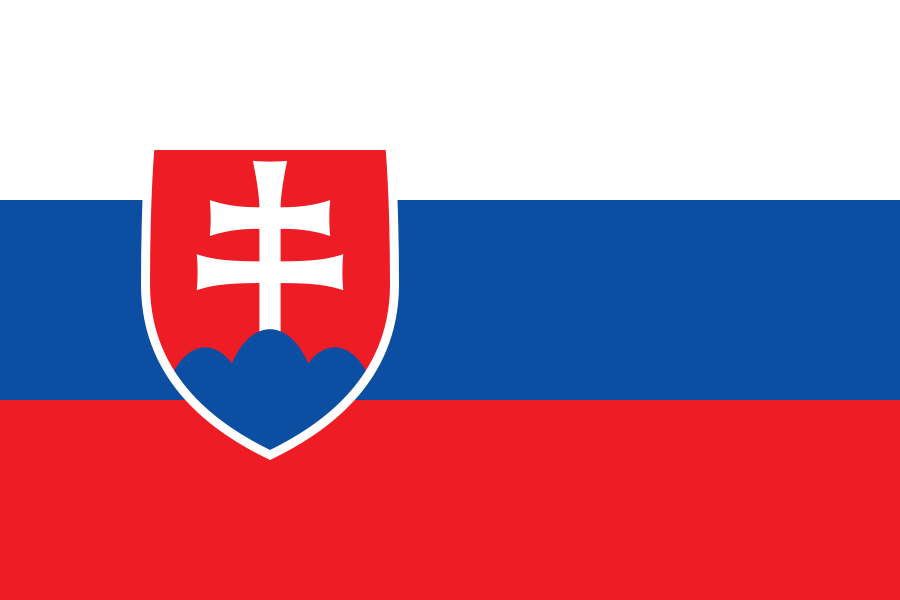
- Cash payments between businesses and between businesses and consumers are permitted up to €5,000.
- Cash payments between private individuals are permitted up to €15,000.
- Higher amounts must be paid by non-cash means.

Cash payments between businesses and between businesses and consumers are permitted up to €5,000.

- Cash payments are permitted up to €1,000 if a business or self-employed person is involved in the payment.
- Exception: for people who are not tax resident in Spain and who are not acting in a professional capacity, the cash payment limit is €10,000.
- The cash payment limits do not apply to payments between private individuals.
- Violations may be subject to a fine of 25% of the amount paid in cash.

- There is no statutory cash payment limit.
- Businesses can decide for themselves whether to accept cash. However, they must inform their customers of this before the purchase.
- From €5,000, certain businesses are subject to anti-money laundering due diligence and identification requirements. These include retailers, banks, bureaux de change, estate agents, casinos and pawnbrokers.

- There is no statutory cash payment limit.
- Businesses can generally decide for themselves whether to accept cash as a means of payment.
*The information comes from our colleagues in the European Consumer Centres Network and was last checked in 2026. We make no claim to completeness.
You might also be interested in
Funded by the European Union. Views and opinions expressed are however those of the author(s) only and do not necessarily reflect those of the European Union or the European Innovation Council and Small and Medium-sized Enterprises Executive Agency (EISMEA). Neither the European Union nor the granting authority can be held responsible for them.
Was this article helpful for you?